Minnesota’s guaranteed rates have me earning around $39 an hour. So who is footing the bill? I went through my own Uber and Lyft receipts to find out.
Driver pay here in Minnesota is good enough that a lot of people wonder whether other states are actually subsidizing it.
I recently made a video about earning nearly $39 per hour over a 20-hour stretch under Minnesota’s guaranteed minimum rate structure. The same comment came in again and again: Uber and Lyft must be using money from other markets to cover the guaranteed rates here. So I decided to dig into my numbers, see what riders are actually paying, and get an idea of what is going on.
Short answer: based on my own rides, other states are not subsidizing Minnesota driver pay. Riders are paying for it, and Uber and Lyft are keeping a smaller share of each fare.
How Minnesota’s Guaranteed Rates Work
Since December 1, 2024, Minnesota drivers have had guaranteed rates of $1.28 per mile and $0.31 per minute while transporting a rider. Those rates have been in place for almost two years now.
There is a catch that matters for this question. Uber and Lyft do not have to pay the guaranteed rate on every single ride. Instead, there is a two-week top-off structure. If, after two weeks, I have not earned what the guaranteed rates would have paid, they send me a top-off payment to make up the difference.
That means the real split between me and the company is not visible on any one trip. I only see it after the top-off arrives, so I ran the numbers for both apps.
My Lyft Numbers
I started with Lyft. This week I gave 27 rides, and here is how it broke down:
- Initial earnings (the upfront fares): $438.93
- What the guaranteed rates would have paid: $555.71
- Top-off Lyft owes me: $116.78
- Total rider payments, not including tips: $699.37
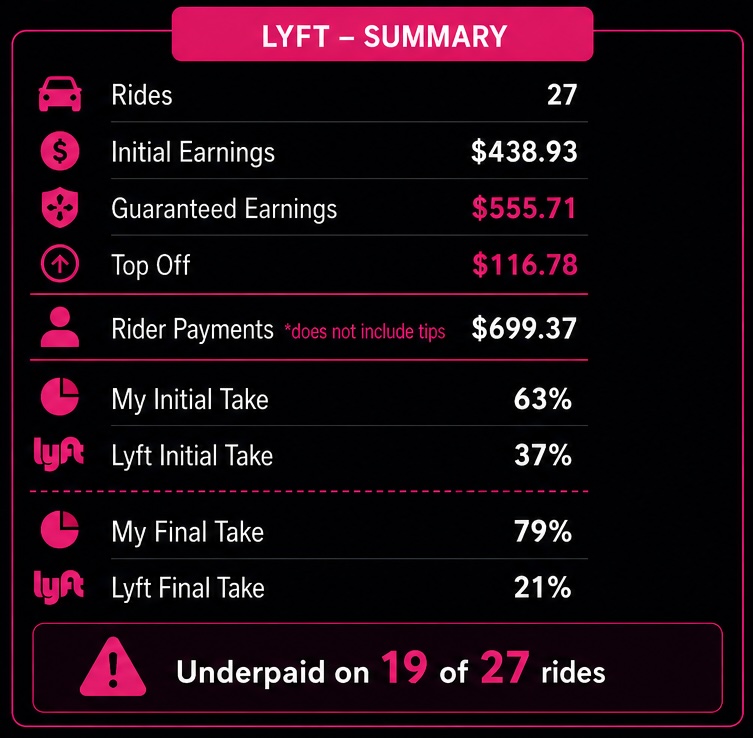
Before the top-off, I was getting 63% of what riders paid and Lyft was keeping 37%. I am guessing that is close to what drivers see in most markets across the country with upfront fares.
After the top-off, my final take is 79%, which leaves Lyft with 21%. Lyft’s upfront fare also came in below the guaranteed rate on most trips. It underpaid me on 19 of my 27 rides.
My Uber Numbers
I drive a lot fewer Uber rides each week, so my Uber sample covers a three-week span. It comes to 24 rides:
- Initial earnings: $311.45
- What the guaranteed rates would have paid: $410.45
- Top-off Uber owes me: $99.00
- Total rider payments, not including tips: $535.59
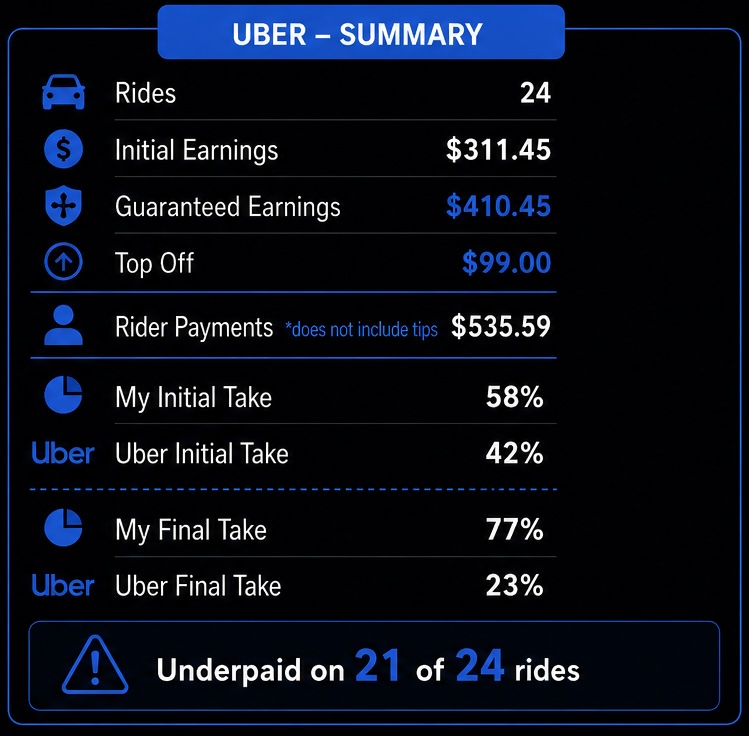
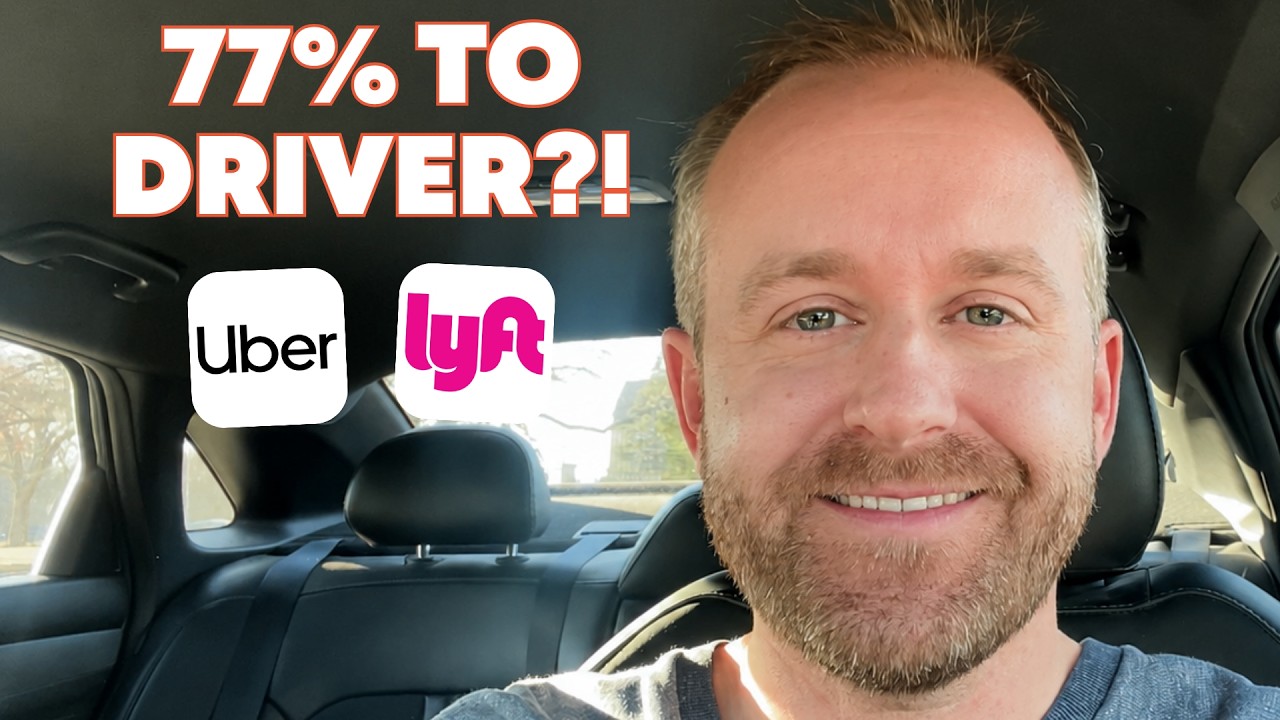
My initial take on Uber would have been 58%, with Uber keeping 42%. Again, I think that is mostly what it looks like nationwide under upfront fares. After the top-off, my final take is 77% and Uber’s is 23%. Uber underpaid me on 21 of the 24 rides I gave.
What the Numbers Tell Me
Put the two apps side by side and the pattern is clear. Under upfront pricing, the company’s cut ran between 37% and 42% of what the rider paid. After the guaranteed rates kicked in, it dropped to roughly 21% to 23%.
That looks eerily similar to the early days of Uber and Lyft, when drivers were paid a percentage of every single fare. I believe my compensation back then was 80%. I would get 80% of every ride and Uber or Lyft would take 20%. My numbers now are very close to that.
So from what I can see, other states are not subsidizing Minnesota driver pay. Riders are footing the bill, and Uber and Lyft are having to operate at more realistic margins than they do under upfront fares. Basically, they are operating like they did when they originally launched about ten years ago. And Uber and Lyft are doing just fine here in Minnesota.
A Few Caveats
This is one driver’s experience, and the sample is small: 27 Lyft rides in one week and 24 Uber rides over three weeks. The rider payments I am comparing against do not include tips. And this is a comparison of take rates, not expenses. Several viewers asked about insurance, operating costs, airport fees, and taxes, and those are fair questions that a take-rate comparison does not answer.
It also only speaks to Minnesota. Drivers in other markets described a very different picture in the comments. One Chicago driver said their take rates are significantly lower than mine, and a Virginia driver said offers have lately been around 50%, with many as low as $0.50 per mile and nothing per minute.
What You Told Me
The comments on my video were split, and some of the pushback was thoughtful.
One viewer who has driven in both Tampa and Boston disagreed with my conclusion. They said Boston has a guaranteed hourly rate with a two-week top-off, similar to ours, and that Uber seems to price rides off very different base rates depending on the market. In Tampa, they said, it looked like roughly $17 an hour for pickup and drive time. In Boston, that same basis was closer to $30. Their question was where the money for the extra pay and benefits comes from if not from somewhere else. My numbers cannot settle that, because they only cover my own Minnesota rides.
Plenty of other viewers simply wanted what we have here. One said guaranteed rates should exist in every state, not just a few. A driver in Nashville said it is a busy market, but the pay is some of the worst in the country.
Where I Land
Here is where I come down. Riders are paying for the higher driver pay, and Uber and Lyft are operating at more realistic margins. I believe upfront fare calculation should go away forever, and all markets should have minimum guaranteed rates in place.
If you drive somewhere without a guarantee, pull your own weekly numbers and compare what riders paid to what you earned. That ratio shows how much of each fare actually reaches you.
What do you think? Did you think other states were subsidizing driver pay here in Minnesota? Tell me in the comments below the article.
Transcribed from a video by Joe Pierce.