On paper, Lyft’s new policy sounds like a win for drivers. A 30% monthly fee cap, simplified deductions, and a promise of “clarity” on earnings all suggest a company finally responding to long-standing driver frustration.
But if you read the announcement carefully and more importantly, if you understand how rideshare economics actually work, the picture becomes less about empowerment and more about reframing control of the narrative.
This is a skeptical breakdown of what Lyft is really changing, and what hasn’t changed at all.
The Core Claim: “We’ll Never Take More Than 30%”
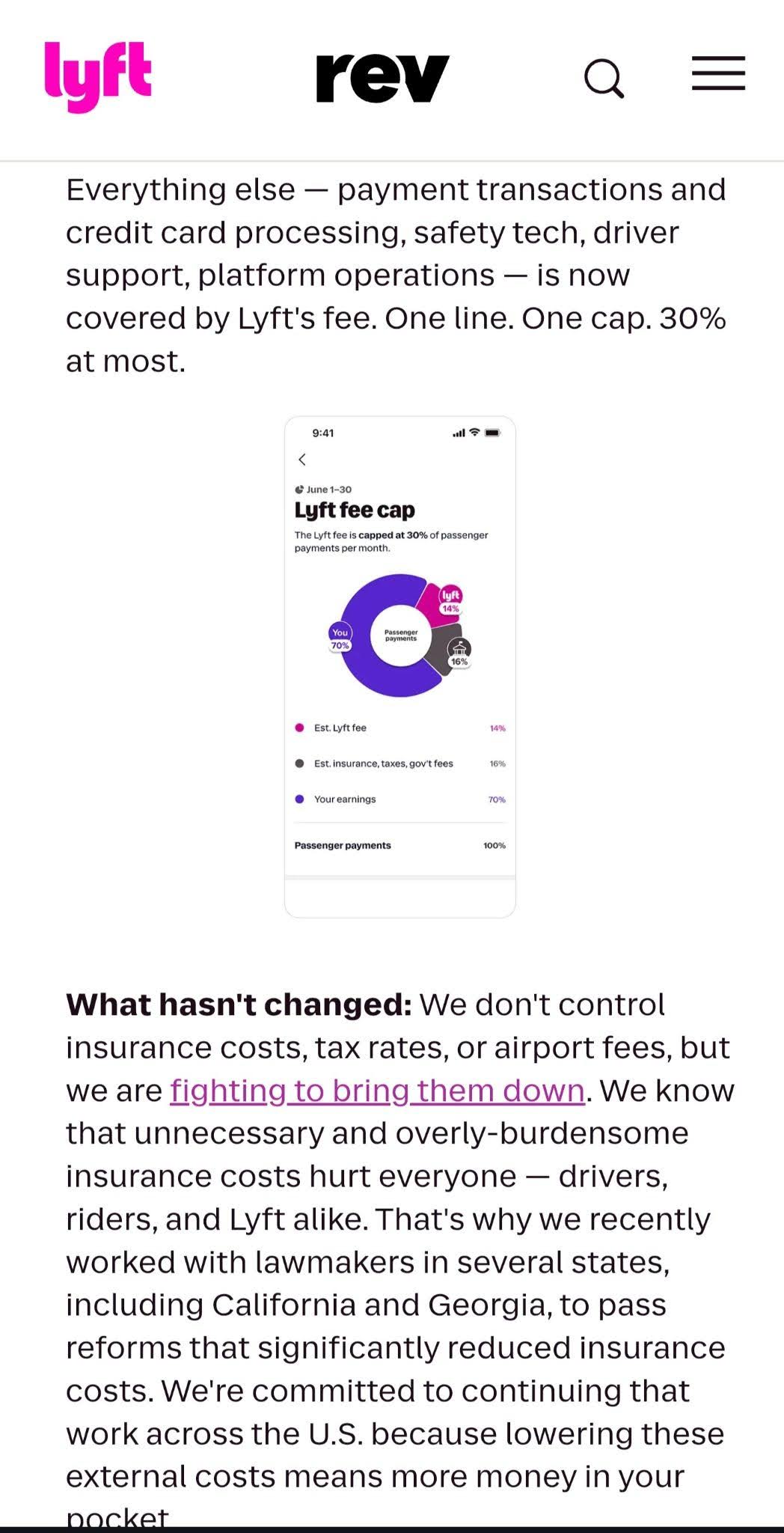
At the center of the announcement from Lyft is a bold guarantee: Lyft will cap its fee at 30% of passenger payments per month. That sounds simple. Even protective.
But here’s the first reality check:
👉 This is a monthly, blended average cap not a per-ride cap.
That means:
- Some rides can still exceed 30% commission
- High-fee rides can be offset by low-fee rides
- Drivers don’t actually see a consistent ceiling per trip
So while the average is capped, the experience on the ground remains uneven.
The “We’re Only 14% on Average” Framing
Lyft repeatedly emphasizes that: “Our average fee is around 14%.”
This is doing a lot of rhetorical work.
Because if the average is already 14%, then:
- The 30% cap rarely triggers meaningful payouts
- The policy sounds stronger than its real-world impact
- The “win” is mostly theoretical for most drivers
In other words, the cap protects against a scenario Lyft says rarely happens anyway.
That’s not necessarily wrong but it raises the question:
👉 If the cap almost never matters, what exactly is being improved?
The Real Shift: Redefining “External Fees”
The most important change is not the cap itself, but the accounting structure behind it.
Lyft is now splitting costs into:
Lyft-controlled fee includes:
- Platform operations
- Safety systems
- Driver support
- Marketing
- Payment processing fees
“External fees” now include:
- Insurance
- Taxes
- Government fees
On paper, this looks like simplification.
In practice, it does something more subtle:
👉 It moves more cost categories into Lyft’s discretionary bucket.
By absorbing payment processing and other costs into its “fee,” Lyft gains flexibility in how it defines revenue vs. operational cost without changing what drivers actually earn per ride.
The Monthly Adjustment Illusion
The policy hinges on one key promise: If Lyft exceeds 30% in a month, drivers get an automatic adjustment.
But here’s the catch:
1. You only see it after the month ends
This means:
- No real-time protection
- No per-ride correction
- No visibility into earnings fairness while working
2. It smooths volatility rather than changing structure
Drivers aren’t being paid differently upfront, only reconciled later.
That creates a perception of fairness without necessarily changing day-to-day economics.
“Clarity and Transparency” vs. Actual Control
Lyft repeatedly uses language like:
- “clarity”
- “predictability”
- “transparency”
But transparency doesn’t automatically mean control.
The key question is:
👉 Do drivers gain any real ability to predict or improve earnings mid-shift?
The answer appears to be no.
Drivers still cannot:
- See true ride-level margin in real time
- Influence fee structure per trip
- Verify external fee allocations independently
So while reporting may be cleaner, power dynamics remain unchanged.
Why the Monthly Structure Matters More Than the Cap
One of the most important design choices in this system is the shift to monthly accounting.
Lyft argues this reduces “short-term fluctuations.”
But skeptically, it also:
- Reduces visibility into individual ride economics
- Makes it harder for drivers to identify underperforming trips
- Delays any corrective payout
A weekly system at least gives feedback loops. A monthly system blurs them.
The Competitive Angle: “We’re the Only Platform Doing This”
Lyft also positions itself against competitors, implying it is the only major platform offering this kind of cap.
That framing matters because it:
- Creates a perception of industry leadership
- Encourages driver loyalty
- Repositions a financial policy as a moral one
But the key missing comparison is not marketing its outcomes:
👉 Does this materially increase driver earnings per hour?
The announcement never clearly answers that.
What Drivers Will Actually Notice
Stripping away the language, most drivers will experience one of three outcomes:
1. No noticeable change
If you already operated near the average, nothing shifts.
2. Slight adjustment volatility
Some drivers may see:
- Larger end-of-month corrections
- Less predictable earnings reconciliation
3. More complexity, not less
Despite “simplification,” the system now includes:
- A capped fee
- External fee categories
- Monthly recalculations
- Delayed adjustments
That’s not necessarily simpler in practice.
My Skeptical Bottom Line
This is not a broken policy but it is a carefully structured one.
The 30% cap:
- Sounds like protection
- Functions as a ceiling on averages
- Rarely affects day-to-day earnings
The real innovation here is not driver protection, it’s standardizing how Lyft presents its take rate.
And that distinction matters. Because in rideshare economics, the most powerful shift isn’t what changes on paper…
It’s what changes in what drivers can actually predict, control, and verify while they’re on the road.
And on that front, the system looks a lot more familiar than the announcement suggests.