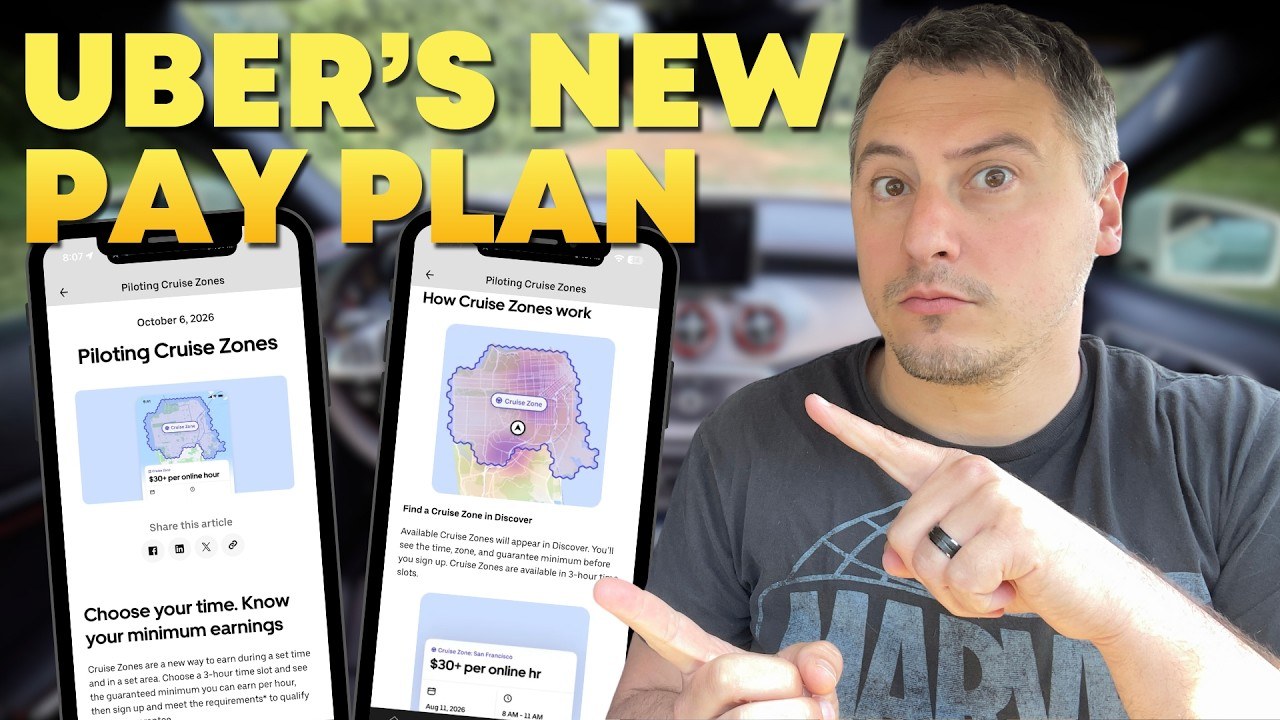
Uber is testing something new with drivers called Cruise Zones, and at first glance it sounds great. Uber shows you an area, gives you a three-hour window, and promises $30 or more per online hour. You stay inside the zone, your trips stay inside the zone, and if you do not hit the guaranteed minimum, Uber covers the difference. No long trips dragging you halfway across the city.
Where do I sign up? Not so fast. Cruise Zones could be useful for some drivers, but there are some big catches in the fine print.
What Are Uber Cruise Zones?
Cruise Zones are being piloted with select drivers in select cities. If one is available to you, it shows up under Discover in the Uber driver app. You see three things before signing up: the time, the zone, and the guaranteed minimum. Uber’s example is a zone in San Francisco from 8 a.m. to 11 a.m. offering $30 plus per online hour.
You do not have to work all three hours. If you start late or go offline early, Uber adjusts your guarantee based on the time you actually spend in cruise mode. At $30 per online hour, two hours in cruise mode means a $60 guarantee.
How the Pay Works
Once you are in cruise mode, Uber sends you only trips that start and end inside the zone. That is probably the most appealing part. If you do not want a 45-minute trip out of your area, or an airport run pulling you away from downtown, this keeps you where you want to be.
But the pay works differently. Trip requests show the total trip time instead of the normal upfront fare. Your trip earnings are calculated at a flat rate per active hour, from accepting the trip until drop-off. When your session ends, Uber compares your eligible trip earnings with your adjusted guarantee and tops you up if you fall short.
Here is Uber’s own example. The guarantee is $30 per online hour and you are in cruise mode for two hours, so your minimum is $60. Your trips generate $50, Uber adds $10, and you finish with $60. Tips and eligible Uber Pro perk earnings are on top of that and do not count toward the top-up.
One distinction matters. The guarantee is based on your online time, but individual trips are paid on active time. If you are online for an hour but actively completing trips for 35 minutes, your trip earnings reflect those 35 minutes, and the guarantee is what lifts you to the minimum. So $30 per online hour is a minimum earnings guarantee, not a change to the economics of every trip.
The Catch

To qualify and stay in cruise mode, you have to sign up for the zone, go online inside it during your time slot, stay inside it, complete at least one trip, and decline or cancel no more than two trips in total.
Think about what that adds up to: a guaranteed hourly minimum, a fixed area, no upfront fare, and a tight limit on turning down offers. One of the biggest advantages of upfront pricing was that you could look at an offer and decide whether it made sense for you. Cruise Zones take most of that away. After two declines or cancellations, you hit the limit for staying in cruise mode.
Why Uber Wants This
Uber has riders requesting trips across a city, but drivers are not always where Uber wants them. Surge, quests, promotions, heat maps and bonuses all try to move drivers around. Cruise Zones add another tool: we will guarantee you at least this much if you commit to this area during this window. Uber gets a predictable pool of drivers in a defined area, and because those drivers have very few declines, they are more likely to actually accept the requests Uber sends them.
Put it next to what else Uber has been doing lately: bigger referral bonuses, incentives to bring inactive drivers back, quest changes that encourage higher acceptance, and even surveys asking drivers why they decline trips. None of that proves a nationwide driver shortage, but together it is worth watching. Uber seems very interested in getting drivers online and getting them to accept more of the trips Uber needs completed.
When It Could Work for You
This is not automatically bad. If Uber offers $35 an hour to stay in an area you already want to work, during a slow period, and guarantees your earnings if demand is weak, that could be a good deal. It could also help if you only have three hours before picking up your kids or heading to another job, and you want to know you will not get dropped 40 miles away.
The test is what you give up compared with what you would normally make. If you usually gross $35 to $40 an hour on a busy Friday night, a $30 guarantee barely matters, because you would have beaten it anyway, and you lose most of your ability to decline rides. If it is a Tuesday afternoon and you normally struggle to gross $20 an hour, a $30 guarantee is a completely different conversation. The guarantee has to pay you for the flexibility you give up.
Do Not Forget Your Costs

$30 per online hour is gross revenue, not profit. You are still burning gas or electricity, putting miles on the car, and paying for maintenance, depreciation, insurance and taxes. And because the normal upfront fare is not displayed, pay close attention to your mileage. A $30 guarantee where you drive 15 miles in the hour is very different from $30 where you drive 35.
If Cruise Zones Come to Your Market
I would test one, but track everything: how long you were online, how much active time you had, how many miles you drove, what the trips generated on their own, how much Uber had to top up, how many requests you received, and how your dollars per mile and dollars per hour compare with what you normally earn.
If drivers consistently make more money with less dead mileage and better control over where they work, Uber may have something useful here. But if drivers mostly earn what they would have earned anyway while giving up upfront fares and most of their ability to decline, this looks less like an earnings benefit and more like a driver positioning tool.
Key Takeaways
Cruise Zones may genuinely help in slow periods or in areas you already like to work, but only if the guarantee beats what you would normally earn. Compare the offer to your own numbers before you give up your ability to decline rides.
Your Turn
Would you do this? Would you accept $30 an hour guaranteed for three hours, with every trip inside the zone, no upfront fare, and only two declines? How high would the guarantee need to be before you would give up cherry-picking: $30, $35, $40, $50?
Let us know in the comments. And if Cruise Zones have already appeared in your market, tell us what Uber offered, what city you are in, and what you actually earned.
Watch the full video:
Transcribed from a video by Chris Gerace at The Rideshare Guy.
Be Safe Out There.